Kerala UNESCO heritage sites: A guide to the Western Ghats and heritage places

Table of contents:
- Key Takeaways
- What UNESCO status means for Kerala
- The Western Ghats are Kerala’s UNESCO World Heritage connection
- Why the inscription covers a serial property across several states
- How World Heritage status differs from national protection
- Why popular heritage attractions may not be UNESCO-listed
- Where to find the Western Ghats sites in Kerala
- The Agasthyamalai cluster in the south
- The Periyar cluster and its protected landscapes
- The Anamalai cluster and its mountain habitats
- How to check boundaries before planning a visit
- What makes the Western Ghats significant
- Exceptional biodiversity and endemic species
- The role of the mountain range in shaping regional climate
- Forest types, watersheds and varied elevations
- Conservation challenges facing the landscape
- Planning a visit to Kerala’s UNESCO-recognised landscapes
- Choosing a base near the relevant protected area
- Checking permits, opening times and seasonal access
- Finding guided walks and wildlife experiences
- Allowing for travel times between mountain regions
- Exploring Kerala’s heritage beyond UNESCO designation
- Historic palaces, forts and religious landmarks
- Traditional architecture and living cultural practices
- National parks and other protected areas
- How to describe these places accurately in a travel plan
- Checking listings and travelling responsibly
- Verifying current information on UNESCO’s official site
- Distinguishing World Heritage sites from tentative-list entries
- Respecting wildlife rules and local communities
- Reducing your impact in fragile mountain environments
- Conclusion
- Frequently Asked Questions
- How many UNESCO World Heritage sites are in Kerala?
- Which Western Ghats clusters are in Kerala?
- Is the whole Western Ghats mountain range UNESCO-listed?
- Are Kerala’s forts and palaces UNESCO World Heritage sites?
- Can you visit every UNESCO component in Kerala?
- When should you visit the Western Ghats in Kerala?
- What is the difference between a World Heritage site and a Tentative List entry?
Key Takeaways
The Western Ghats are Kerala’s connection to UNESCO’s natural World Heritage List, but the inscription covers a much wider landscape than any single park or viewpoint. A little planning helps you understand what is listed and visit the mountains with care.
The Western Ghats are one serial World Heritage property spanning several Indian states.
Kerala’s part of the property is grouped into the Agasthyamalai, Periyar and Anamalai clusters.
World Heritage status is distinct from national park and wildlife-protection designations.
Access, permits and seasonal conditions vary between protected areas.
Kerala’s palaces, forts, religious landmarks and living traditions are valuable heritage, whether or not they are UNESCO-listed.
What does UNESCO status mean for Kerala?
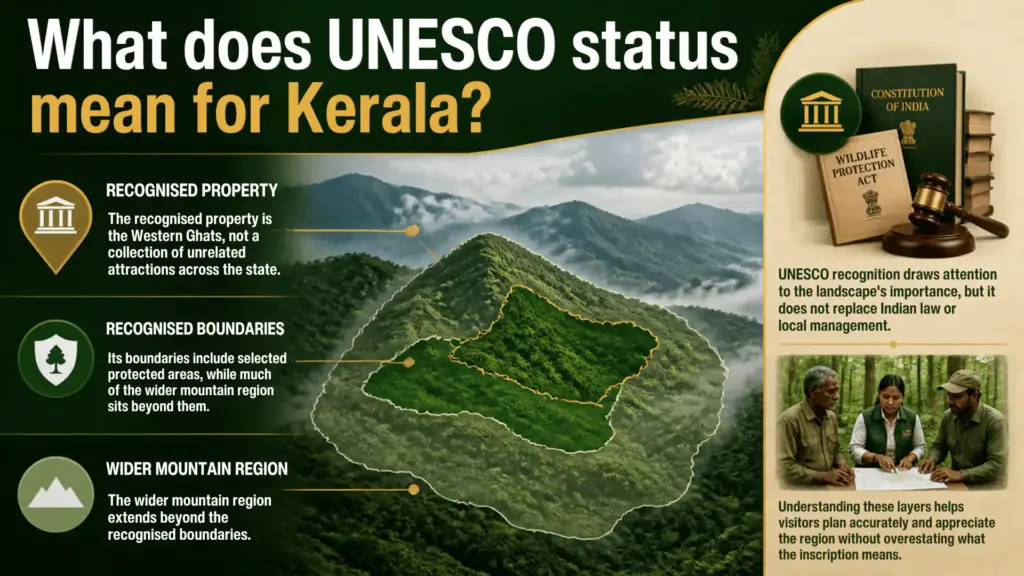
When you search for Kerala UNESCO heritage sites, it helps to start with a small distinction: the recognised property is the Western Ghats, not a collection of unrelated attractions across the state. Its boundaries include selected protected areas, while much of the wider mountain region sits beyond them. UNESCO recognition draws attention to the landscape’s importance, but it does not replace Indian law or local management. Understanding those layers makes it easier to plan accurately and appreciate the region without overstating what the inscription means.
The Western Ghats are Kerala’s UNESCO World Heritage connection
Kerala’s World Heritage connection is natural rather than architectural: selected parts of the Western Ghats form part of the UNESCO-listed property. The mountain chain runs along the state’s eastern edge, where forests, ridges and valleys meet the landscapes of neighbouring states. The Western Ghats is recognised for its natural importance, including its exceptional biodiversity. For you as a visitor, this means that a beautiful mountain stop is not automatically a listed component; the precise protected area matters.
Why the inscription covers a serial property across several states
The inscription is a serial property: it brings together separate protected areas that collectively illustrate the value of the Western Ghats. The components are arranged in clusters across four states, rather than forming one continuous UNESCO boundary. That structure reflects the range of habitats and ecological features found along the mountain chain. It also means you should think of Kerala’s clusters as parts of a larger shared landscape, not as a standalone World Heritage site with a single entrance or visitor centre.
How World Heritage status differs from national protection
World Heritage status recognises a place’s significance to people around the world, while national and state laws establish the practical rules for protecting and managing particular areas. In Kerala, a national park, tiger reserve or wildlife sanctuary can have its own legal designation, boundaries and visitor regulations. A UNESCO inscription does not mean every nearby forest is open to visitors, nor does it create a general permit to enter protected land. Check the rules set by the relevant authorities before you travel.
Why popular heritage attractions may not be UNESCO-listed
A place can be deeply important to Kerala’s history and identity without being part of the World Heritage List. Forts, palaces, temples, churches and historic quarters may be protected under other systems or valued for their local and cultural significance. UNESCO recognition is a specific international designation, not a ranking of everything worth seeing. Keeping that distinction in mind lets you include both natural and cultural heritage in your plans while describing each place accurately.
Where to find the Western Ghats sites in Kerala?
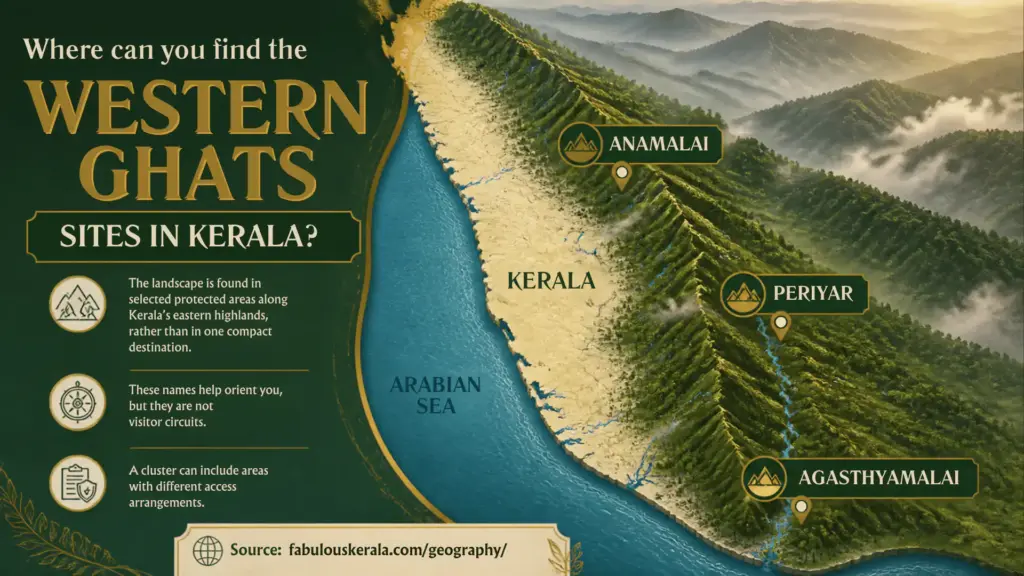
The listed landscape is found in selected protected areas along Kerala’s eastern highlands, rather than in one compact destination. Three clusters are associated with Kerala: Agasthyamalai in the south, Periyar farther north, and Anamalai in the central-northern highlands. The names help orient you, but they are not visitor circuits, and a cluster can include areas with different access arrangements. The geography of Kerala offers useful context for how the mountain range, rivers and coast fit together.
The Agasthyamalai cluster in the south
In the south, the Agasthyamalai cluster includes protected landscapes around the southern end of Kerala’s Western Ghats. Areas such as Neyyar, Peppara and Shendurney are part of this wider forested setting, though their visitor facilities and permitted activities are managed separately. The landscape rises from lowland forest into mountain habitats, so conditions can change quickly with altitude and weather. If you are heading this way, identify the specific reserve or access point you hope to visit rather than relying on the cluster name alone.
The Periyar cluster and its protected landscapes
The Periyar cluster is centred on the highland forests of the Periyar region, a landscape familiar to many travellers through Thekkady. The protected area is known for forest, water and wildlife experiences, but the exact activities available depend on current management and local conditions. If you are considering a stay nearby, this Thekkady travel guide can help you understand the area’s visitor options and plan around the reserve. Treat the UNESCO cluster and the tourism destination as related but not interchangeable: the first describes a listed component, while the second is a broader place to stay and explore.
The Anamalai cluster and its mountain habitats
The Anamalai cluster covers protected landscapes in Kerala’s central-northern highlands, where mountains, grasslands and forest habitats occur across varied elevations. Eravikulam, Chinnar and Parambikulam are among the protected areas associated with this part of the Western Ghats. Their scenery and wildlife differ, and each has its own access arrangements, so it is worth checking the individual park or reserve rather than assuming one set of rules applies everywhere. If you are drawn to Munnar, remember that nearby attractions and listed components do not always share the same boundary.
How to check boundaries before planning a visit?
Before booking a stay or a guided outing, match the place name on your itinerary to an official protected-area map or current park information. This is especially useful when accommodation, viewpoints and trekking routes use a familiar regional name that covers a wider area than the UNESCO component. The table below gives a broad orientation, not a substitute for checking exact boundaries and access.
Kerala cluster | Broad location | Planning note |
|---|---|---|
Agasthyamalai | Southern highlands | Check the rules for the specific reserve and entry point. |
Periyar | Thekkady and surrounding highlands | Confirm which activities are currently available. |
Anamalai | Central-northern highlands | Check access separately for each park or reserve. |
Use this as a starting map in words, then confirm the site details with the relevant authority before travelling. It can save you from assuming that a road, trail or viewpoint falls within the listed area simply because it is nearby.
What makes the Western Ghats significant?
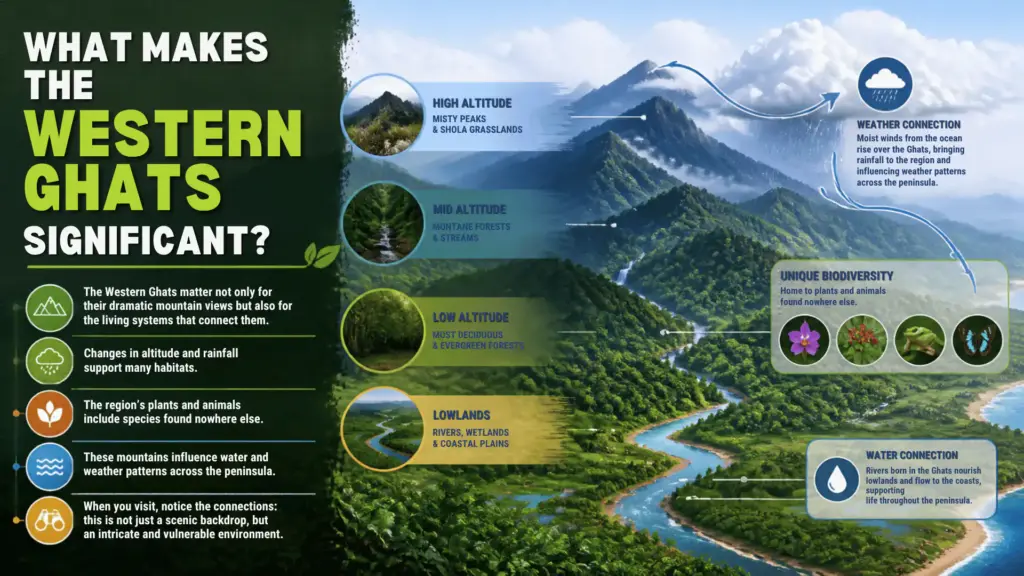
The Western Ghats matter not only for their dramatic mountain views but also for the living systems that connect them. Across the range, changes in altitude and rainfall support many habitats, while the region’s plants and animals include species found nowhere else. These mountains also influence water and weather patterns across the peninsula. When you visit, a little attention to those connections makes the landscape feel less like a scenic backdrop and more like an intricate, vulnerable environment.
Exceptional biodiversity and endemic species
The Western Ghats are recognised for rich biodiversity and a high level of endemism, meaning some species occur naturally only in this region. Forests and grasslands support a variety of plants, amphibians, birds and mammals, though seeing wildlife is never guaranteed on a visit. Quiet observation is often more rewarding than searching for a particular animal. Keep to authorised routes and give wildlife room to move; the health of a habitat matters more than a photograph.
The role of the mountain range in shaping regional climate
The mountain chain influences how seasonal winds and rain move across southern India. On the western slopes, the monsoon brings substantial rainfall, while elevation and topography help create differences between nearby areas. These patterns feed rivers and shape the forests and cultivated landscapes you encounter. Kerala’s climate is not identical from one district or season to the next, so use current forecasts for the specific highland destination rather than relying on a general statewide description.
Forest types, watersheds and varied elevations
As you travel through the Western Ghats, forest types and vegetation shift with elevation, rainfall and local conditions. Evergreen forests, montane grasslands and patches of shola woodland are among the habitats found in the wider range. The mountains also form important watersheds, with streams and rivers carrying water towards the lowlands. A short road journey can cross several ecological zones, which is one reason access and weather can feel quite different between neighbouring areas.
Conservation challenges facing the landscape
A landscape can be internationally recognised and still face pressures. Roads, development, habitat fragmentation, invasive species, changing climate and human-wildlife encounters all require careful management in different parts of the region. These challenges are complex, and their effects vary by location; avoid assuming that a single visit or viewpoint tells the whole story. For travellers, respectful behaviour is a practical contribution: follow local guidance, avoid disturbing animals and leave natural materials where you find them.
Planning a visit to Kerala’s UNESCO-recognised landscapes
A visit to the Western Ghats is easier to enjoy when you choose one area as your focus instead of trying to cover every cluster in a short trip. Roads through the highlands can be slow, and entry rules differ between parks and reserves. Build your plans around the place you can actually access, then check the details close to your travel date. Fabulous Kerala offers practical guidance for planning a Kerala visit, including advice on routes and travel experiences; use it as inspiration alongside current information from local authorities.

Choosing a base near the relevant protected area
Choose your base according to the protected area and activities you hope to experience, not just the name of a well-known hill station. For a wildlife-focused stay, being near the relevant reserve can reduce early-morning travel, while a town may offer a wider choice of accommodation and food. Fabulous Kerala’s travel guides cover destinations such as Munnar and Thekkady, helping you compare the character of different highland stops before shaping a route. Allow time to settle in; arriving and leaving in a rush can turn a mountain visit into little more than a drive.
Checking permits, opening times and seasonal access
Entry arrangements, opening times and permitted activities can change, so check directly with the park or reserve before setting out. Some walks or wildlife experiences require advance arrangements or must be accompanied by authorised staff. A simple pre-trip check can help you avoid wasted travel and make sure you are prepared for conditions on the day:
Confirm whether you need a permit or advance booking.
Check the latest opening hours and entry point.
Ask about weather-related closures or seasonal restrictions.
Review clothing, footwear and any items the authority recommends.
These checks are particularly useful during heavy rain or periods of high visitor demand. Follow the instructions given locally, even if they differ from older travel information you have saved.
Finding guided walks and wildlife experiences
Guided walks, boat outings and other wildlife experiences may be available in some areas, but the options are set by local management and can vary. A guide can help you interpret the forest and follow the right route; it cannot guarantee sightings. Fabulous Kerala shares information about Kerala’s landscapes and visitor experiences, while the reserve authority is the place to confirm what is operating now. Choose activities that respect wildlife, avoid feeding or calling animals, and make room for quieter encounters.
Allowing for travel times between mountain regions
Distances on a map can be misleading in the hills, where winding roads, weather and local traffic affect journey times. Agasthyamalai, Periyar and Anamalai are distinct areas, and trying to combine them in one hurried transfer day can leave little time to experience any of them. Build in pauses and an overnight stay where needed, especially if your route includes a park visit at a fixed time. A slower itinerary is often the more practical choice, not a compromise.
Exploring Kerala’s heritage beyond UNESCO designation
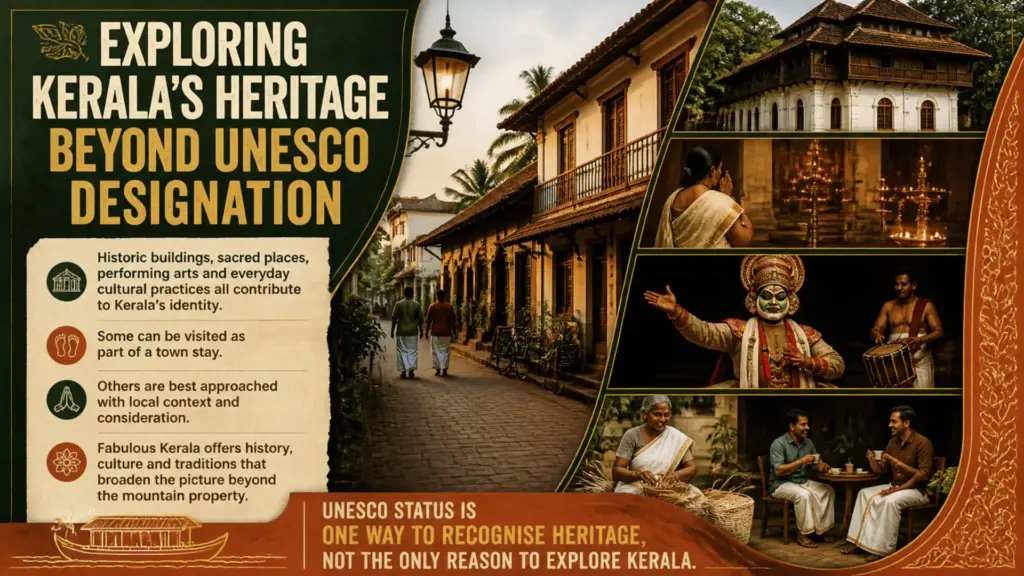
UNESCO status is one way to recognise heritage, but it is not the only reason to explore Kerala. Historic buildings, sacred places, performing arts and everyday cultural practices all contribute to the state’s identity. Some can be visited as part of a town stay, while others are best approached with local context and consideration. Fabulous Kerala shares material on Kerala’s history, culture and traditions, offering a broader frame for the places you encounter beyond the mountain property.
Historic palaces, forts and religious landmarks
Kerala’s historic places reflect long histories of trade, political change and religious life. Fort Kochi and Mattancherry, for example, are known for layered urban heritage, while palaces and religious landmarks across the state tell stories specific to their own communities and periods. These places are not automatically UNESCO-listed, and their conservation status can differ. If you include them in your journey, look for reliable local interpretation and give active places of worship the respect you would expect as a guest.
Traditional architecture and living cultural practices
Architecture and cultural practice are not frozen in the past. You may encounter distinctive timber buildings, craft traditions, festivals, music and performance in settings where people live, worship and work. Approach these experiences with curiosity rather than treating them as staged attractions, and ask before photographing people or ceremonies. Cultural visits are often most meaningful when you leave room for explanation and understand that customs can differ between communities and regions.
National parks and other protected areas
Kerala has protected areas beyond the components of the UNESCO-listed Western Ghats property. A national park or sanctuary may be well worth visiting in its own right, but its conservation designation should not be confused with World Heritage status. Look at the specific location’s official information to understand what is protected, what visitors may do and whether entry is permitted. This also helps you avoid describing a whole district or landscape as UNESCO-listed when only selected components are inscribed.
How to describe these places accurately in a travel plan?
Clear wording helps your itinerary respect the difference between an attraction, a protected area and a World Heritage component. You can name the particular park or historic site you plan to visit, then say whether it is part of the Western Ghats property only when you have verified that connection. Avoid calling every Kerala heritage place a UNESCO site; the designation has a defined scope. This careful phrasing makes a travel plan more useful for you and more trustworthy for anyone reading it.
Checking listings and travelling responsibly
Official listings and local visitor information serve different purposes, so it is worth checking both. UNESCO’s pages explain the property and its international status, while park and reserve authorities provide operational details such as entry rules and closures. Conditions can change, and older travel articles may not reflect current access. Fabulous Kerala is a guide to discovering the state, but for a specific visit you should confirm the latest practical requirements with the authority responsible for that place.

Verifying current information on UNESCO’s official site
Use UNESCO’s official World Heritage information to confirm the name, description and boundaries of the listed property. The listing can clarify that the Western Ghats inscription is a serial property made up of selected components, rather than a blanket designation for every mountain area. Then compare the component information with the protected-area details relevant to your itinerary. For travel-day decisions such as opening hours or route conditions, check the local authority as well.
Distinguishing World Heritage sites from tentative-list entries
A place on a country’s Tentative List is being considered as a possible future nomination; it is not the same as an inscribed World Heritage property. Similarly, a nationally protected area or a locally important landmark does not become UNESCO-listed solely because it is well known or carefully conserved. Check the status and wording of the official record before describing a place. This distinction keeps your expectations, itinerary and explanations grounded in what has actually been recognised.
Respecting wildlife rules and local communities
Follow the instructions of park staff and authorised guides, and keep a respectful distance from wildlife. Do not feed animals, leave food behind or make noise to draw attention to them. In villages and cultural settings, be considerate of privacy and local customs, particularly when taking photographs. The people who live and work in these landscapes are part of their present-day story, not an attraction to be observed without thought.
Reducing your impact in fragile mountain environments
Small decisions can make a difference in places where habitats and visitor facilities are sensitive to pressure. Carry reusable water where practical, take all rubbish back with you and stay on marked routes. Avoid collecting plants, rocks or other natural objects, and use established transport and visitor services where available. Leave enough time to travel safely, especially in rain or mist; responsible choices help protect both the landscape and your own experience of it.

Conclusion
Kerala’s UNESCO connection is rooted in the Western Ghats, a remarkable mountain landscape recognised through selected protected areas across several states. Once you know how the three Kerala clusters relate to the wider property, you can plan a more rewarding visit and speak accurately about what is listed. Pair the mountains with Kerala’s many other cultural and historic places, check practical details close to your trip, and travel with care for the communities and habitats that make the state distinctive.
Frequently Asked Questions
How many UNESCO World Heritage sites are in Kerala?
Kerala forms part of the Western Ghats serial World Heritage property. Its selected protected areas belong to three clusters in the state, rather than constituting several separate properties.
Which Western Ghats clusters are in Kerala?
The three clusters associated with Kerala are Agasthyamalai, Periyar and Anamalai. Each includes selected protected landscapes, and access arrangements vary by area.
Is the whole Western Ghats mountain range UNESCO-listed?
No. The inscription covers selected components of the Western Ghats across several states, not the entire mountain chain or every nearby attraction.
Are Kerala’s forts and palaces UNESCO World Heritage sites?
Kerala’s forts and palaces may have considerable historical and cultural value, but they are not automatically part of the Western Ghats inscription. Check the official World Heritage list for a place’s current status.
Can you visit every UNESCO component in Kerala?
Not necessarily. Visitor access depends on the rules of each park or reserve, and some areas may have restrictions, limited facilities or seasonal closures.
When should you visit the Western Ghats in Kerala?
Conditions vary by region and season. Check local weather, access information and any park-specific guidance for your intended dates before making plans.
What is the difference between a World Heritage site and a Tentative List entry?
An inscribed World Heritage property has been formally added to UNESCO’s list. A Tentative List entry is a proposed candidate and does not have the same status.