
Food & Cuisine of Kerala
Where coconut meets spice, the Arabian Sea meets the Western Ghats, and thousands of years of history are served on a plate.
Taste Kerala

There are many ways to discover Kerala.
You can cruise through its backwaters.
Walk through its spice plantations.
Watch the monsoon sweep across the coast.
Listen to the drums of a festival.
Or you can simply sit down and eat.
Because few things tell the story of Kerala as beautifully as its food.
Kerala cuisine is colourful, aromatic and wonderfully diverse. Rice, coconut, seafood and spices appear throughout its culinary landscape, but travel from one end of the state to the other and you will discover remarkable differences in ingredients, techniques and traditions.
A meal in Kozhikode may be very different from one in Kottayam.
The food served at a Hindu festival may differ completely from a Christian wedding feast.
A Malabar biryani tells one story of Kerala.
A vegetarian sadya tells another.
Appam and stew tell another.
Karimeen pollichathu tells another.
Together, they reveal a cuisine shaped by geography, faith, family, migration and centuries of contact with the wider world.
To understand Kerala, therefore, you should taste it.
A Cuisine Shaped by the Land
Kerala’s food begins with its geography.
The Arabian Sea provides fish, prawns, crab, mussels and other seafood.
The backwaters provide freshwater fish and support distinctive fishing traditions.
The fertile lowlands grow rice.
Coconut palms flourish across much of the state.
The hills and Western Ghats produce pepper, cardamom, ginger, turmeric and other spices.
Bananas, jackfruit, tapioca, mangoes and countless tropical fruits and vegetables thrive in Kerala’s warm climate.
The landscape created the ingredients.
Generations of Malayalees transformed them into a remarkable cuisine.

Coconut – The Flavour of Kerala

If one ingredient could symbolise Kerala cooking, it would probably be the coconut.
The coconut palm is so closely associated with Kerala that it has become part of the state’s visual identity.
Coconut appears in numerous forms.
Fresh coconut may be grated into vegetable dishes.
Ground coconut creates the base for curries.
Coconut milk adds richness.
Coconut oil is widely used in cooking.
Roasted coconut can create deep, complex flavours.
Even coconut husks and shells have traditionally been used outside the kitchen for products such as coir, fuel and household items.
Few ingredients demonstrate the relationship between Kerala’s landscape and cuisine quite so clearly.
The Land of Spices
Kerala’s spices changed world history.
For thousands of years, merchants travelled enormous distances in search of pepper, cardamom, ginger and other valuable products grown in and around Kerala.
Black pepper became so valuable that it was sometimes described as “black gold.”
The spice trade connected Kerala with Arabia, the Mediterranean world and later European powers.
These trading relationships eventually helped bring Portuguese, Dutch and British interests to Kerala’s shores.
Spices therefore did much more than flavour Kerala’s food.
They connected Kerala to the world.
Today, pepper, cardamom, turmeric, ginger, cloves, cinnamon and other spices continue to play important roles in Kerala cooking.
But good Kerala cuisine is not simply about making food extremely hot.
Spices are used to create aroma, warmth, depth and balance.

Rice – The Heart of the Meal

Rice is central to traditional Kerala cuisine.
For generations, paddy fields formed an important part of the state’s agricultural landscape, particularly in areas such as Kuttanad.
Cooked rice accompanies countless curries and side dishes.
Rice is also transformed into an astonishing variety of foods.
Rice flour is used to prepare appam, idiyappam, puttu, pathiri and many other dishes.
Rice therefore appears at breakfast, lunch, dinner, celebrations and religious occasions.
It is not merely an ingredient.
It is part of everyday life.
The Kerala Sadya
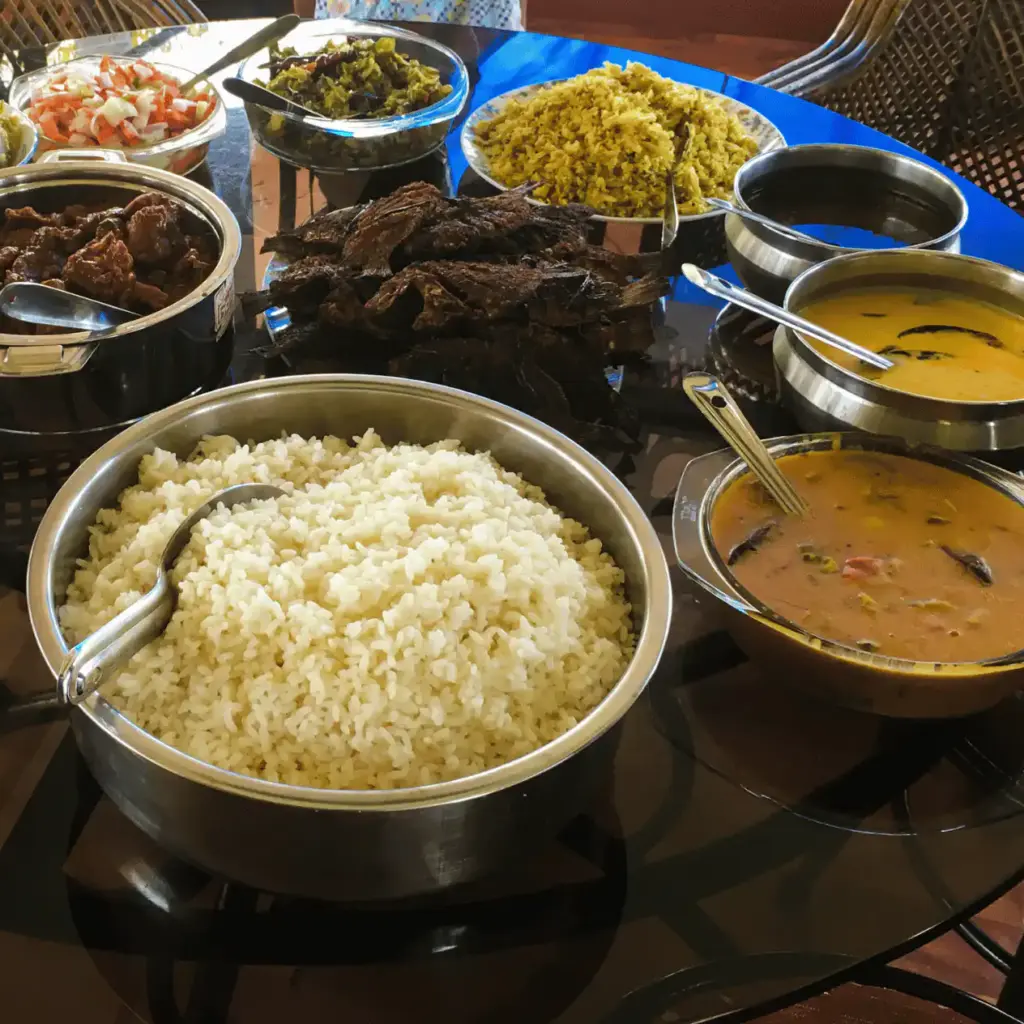
Few meals represent Kerala as spectacularly as the sadya.
Traditionally served on a banana leaf, the sadya is an elaborate vegetarian feast associated particularly with Onam and other important celebrations.
A sadya can contain numerous dishes, each contributing different flavours and textures.
Depending on the occasion and local tradition, these may include:
- Parippu
- Sambar
- Avial
- Olan
- Kaalan
- Thoran
- Pachadi
- Erissery
- Pickles
- Pappadam
- Banana
- Payasam

Rice forms the centre of the meal, with different accompaniments served around it. Eating a sadya is an experience in itself.
Sweet, sour, salty, spicy and savoury flavours appear across the banana leaf. And then comes payasam. Sometimes more than one.
A proper sadya demonstrates an important characteristic of Kerala cuisine:
Variety within harmony.
Each dish has its own personality, yet together they create a complete meal.
Appam and Stew

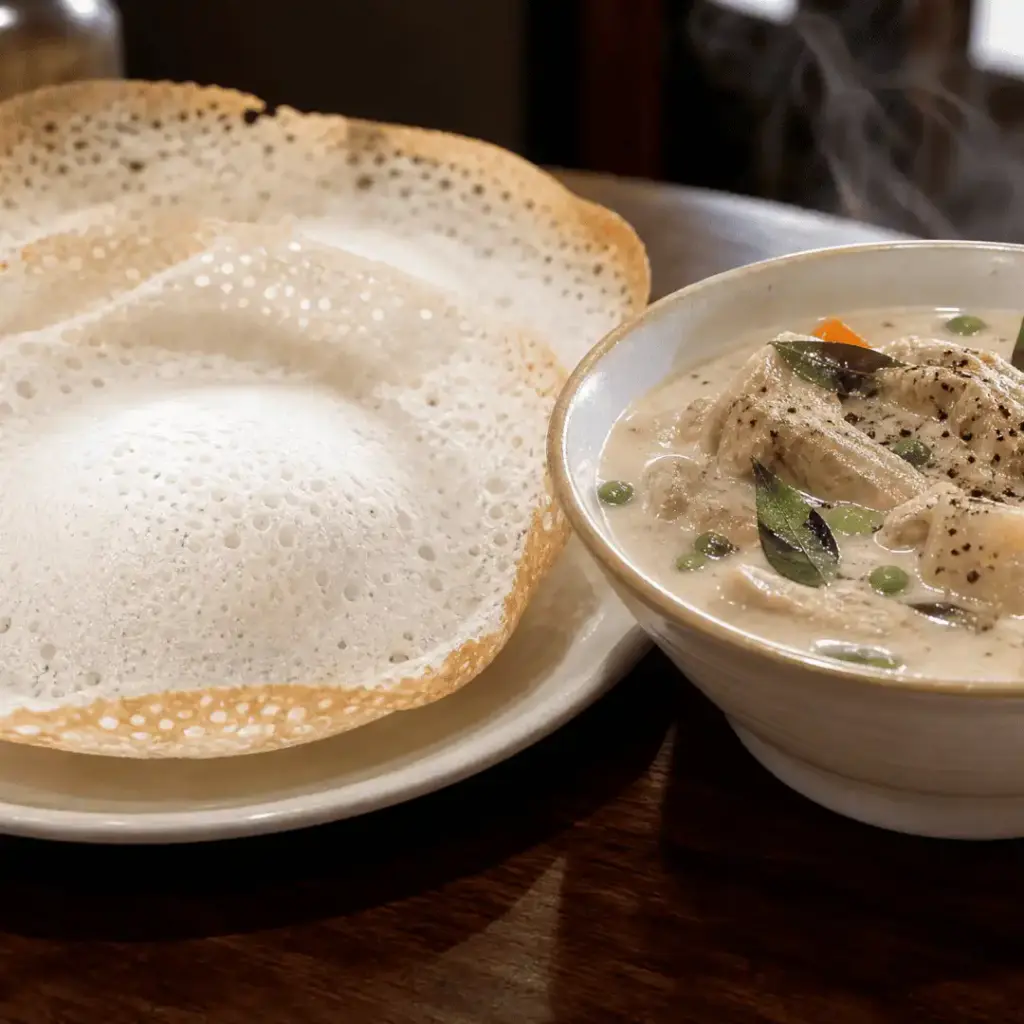
Few breakfasts are more comforting than freshly prepared appam with stew.
Appam is a fermented rice pancake with a soft centre and delicate, crisp edges.
It is commonly eaten with vegetable, chicken or meat-based accompaniments, depending on family and community traditions.
A gently spiced stew made with coconut milk provides a wonderful contrast to the slightly fermented flavour of the appam.
Although particularly associated with Christian culinary traditions in parts of Kerala, appam has become widely enjoyed across communities.
It is simple, elegant and unmistakably Kerala.
Puttu and Kadala Curry
For many Malayalees, puttu and kadala curry represents the taste of home.
Puttu is traditionally prepared by steaming layers of rice flour and grated coconut, producing a distinctive cylindrical dish.
It is often served with kadala curry, made from black chickpeas cooked with spices and coconut.
Puttu can also be eaten with banana, sugar or other accompaniments.
It is filling, nutritious and deeply rooted in Kerala’s breakfast culture.
And like many beloved foods, every family seems to have an opinion about the correct way to eat it.

Idiyappam
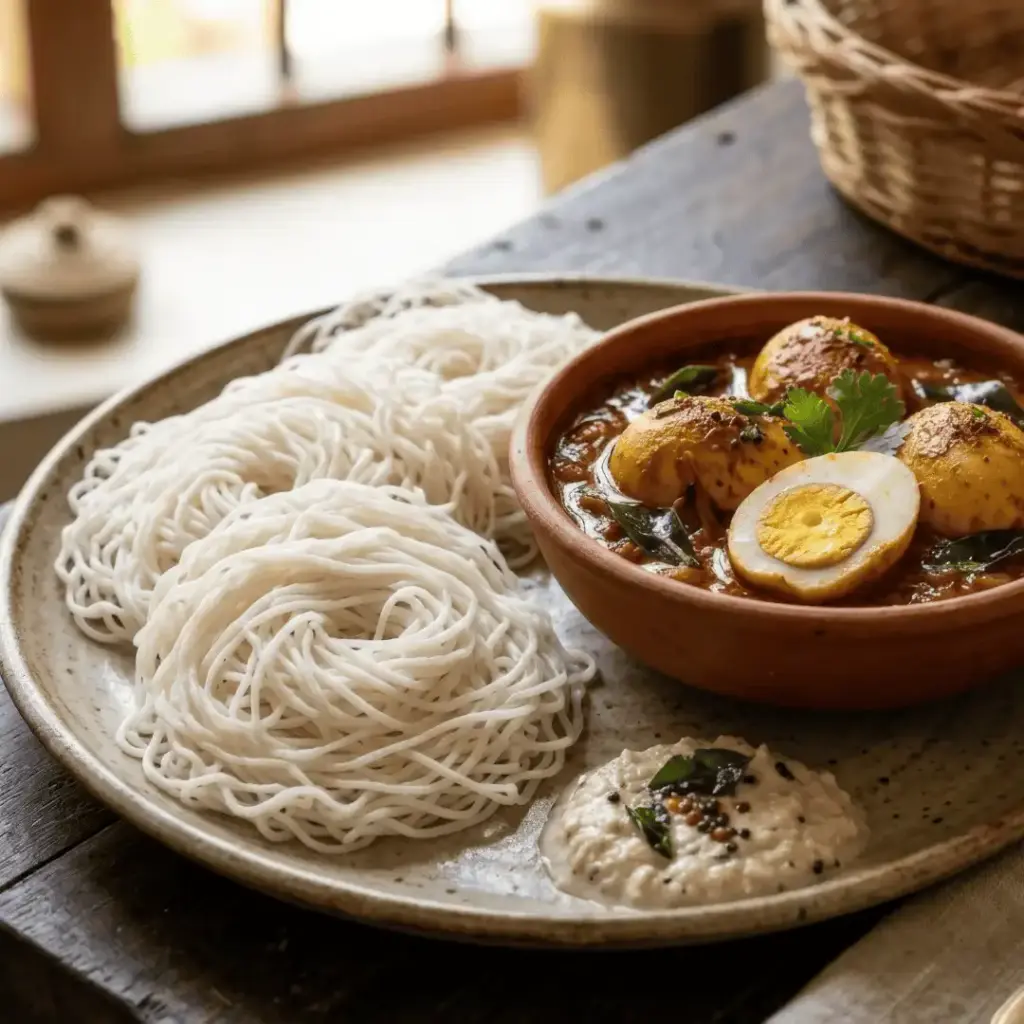
Idiyappam, sometimes described as string hoppers, is made by pressing rice flour dough into fine strands and steaming them.
Soft and delicate, idiyappam works beautifully with coconut milk, vegetable curry, egg curry, stew and numerous other accompaniments.
Its simplicity makes it remarkably versatile.
Dosa and Idli
Kerala shares several dishes with neighbouring South Indian states, including dosa and idli.
But local accompaniments, preparation styles and household traditions give them their own place in Kerala’s breakfast culture.
Crisp dosa with chutney and sambar remains a favourite throughout the state, while soft steamed idlis provide another familiar start to the day.
These foods remind us that Kerala cuisine is distinctive but also part of the wider culinary traditions of South India.

Seafood – A Gift from the Arabian Sea
With hundreds of kilometres of coastline, numerous rivers and an extensive backwater system, it is hardly surprising that fish and seafood occupy an important place in Kerala cuisine.
Fishing communities have developed countless recipes using the day’s catch.
Sardines, mackerel, prawns, crab, mussels, pearl spot and many other varieties appear in local kitchens.
Preparations range from simple fried fish to complex curries flavoured with coconut, tamarind, chilli and spices.
The exact recipe often changes from district to district—and sometimes from one household to the next.
Kerala Fish Curry
here is no single Kerala fish curry.
That is important.
Different regions and communities prepare fish in very different ways.
Some curries use coconut milk.
Others use ground coconut.
Some rely on tamarind.
Others use kudampuli, or Malabar tamarind, which provides a distinctive sourness.
Some are fiery red.
Others are mild and creamy.
Ask ten Malayalee families how to prepare the perfect fish curry and you may receive eleven answers.
That diversity is part of what makes Kerala cuisine fascinating.

Karimeen Pollichathu
Cooking food inside banana leaves is a wonderful Kerala tradition. The leaf helps retain moisture while imparting a subtle aroma to the food.
Fish is particularly suited to this method.The technique also demonstrates how traditional Kerala cooking made intelligent use of materials available naturally in the surrounding environment.
Long before disposable packaging became commonplace, nature provided the wrapper.

One of Kerala’s iconic seafood dishes is karimeen pollichathu.
Karimeen, or pearl spot fish, is closely associated with Kerala’s backwaters.
The fish is typically seasoned with spices and cooked wrapped in banana leaf, often with a richly flavoured masala.
Opening the leaf releases an extraordinary aroma.
It is food that connects directly with Kerala’s waterways, ingredients and traditional cooking methods.
Malabar Cuisine
Travel north towards Kozhikode, Kannur, Malappuram and surrounding areas and Kerala’s cuisine begins to reveal another personality.
Malabar cuisine reflects centuries of interaction between Kerala and Arab traders across the Arabian Sea.Rice dishes, meat preparations, breads and elaborate snacks feature prominently.
The region is particularly famous for biryani.But Malabar cuisine extends far beyond a single dish.Pathiri, seafood preparations, stuffed snacks, meat curries and festive foods reveal a sophisticated culinary tradition shaped by trade, family and faith.
Malabar Biryani
Kerala has its own distinctive biryani traditions.
The biryani associated with areas such as Kozhikode and Thalassery is especially celebrated.
Fragrant rice is combined with meat, spices, fried onions and other ingredients to create a dish that can be aromatic without being overwhelmingly hot.
Different towns and families maintain their own methods.
For many Malayalees, arguments over who makes the best biryani are almost as enjoyable as eating it.

Pathiri

Pathiri is a soft, thin flatbread traditionally made from rice flour and particularly associated with the Muslim communities of Malabar.
It is commonly eaten with meat, chicken or fish curries.
Its mild flavour makes it an ideal partner for richly seasoned dishes.
Simple foods like pathiri demonstrate how rice has been transformed into countless forms across Kerala.
Kerala's Christian Culinary Traditions
Kerala’s ancient Christian communities developed distinctive food traditions over many generations.
Celebrations such as Christmas, Easter, weddings and family gatherings often feature elaborate meals.
Appam and stew are well-known examples, but the tradition extends to meat curries, fish preparations, cutlets, breads, pickles and numerous regional specialities.
In central Kerala particularly, dishes involving duck, beef, pork and fish have become associated with different Christian communities and family traditions.
These cuisines also reveal traces of Kerala’s long contact with European and Middle Eastern cultures.
Kerala's Muslim Culinary Traditions

Muslim communities, particularly across Malabar, have contributed enormously to Kerala’s culinary identity.
Centuries of maritime connections with Arabia influenced ingredients, cooking methods and dishes while blending with local Kerala traditions.
Biryani, pathiri, meat dishes and an extraordinary range of snacks and festive foods form part of this heritage.
Food becomes especially important during celebrations and family gatherings, where hospitality is expressed through generous meals.
Hindu Culinary Traditions
Kerala’s Hindu communities have contributed an enormous variety of vegetarian and non-vegetarian culinary traditions.
Temple cuisine, festival foods and household cooking vary considerably according to region and community.
The vegetarian sadya is perhaps the most famous expression of this heritage.
Dishes based on vegetables, lentils, coconut, yoghurt and spices demonstrate how extraordinarily varied vegetarian cooking can be.
Many temple towns also developed distinctive foods associated with religious traditions and offerings.
Vegetarian Kerala

Although seafood and meat receive considerable attention, Kerala offers extraordinary vegetarian food.
Vegetables are transformed through coconut, spices, lentils, yoghurt and traditional techniques.
Avial, for example, combines several vegetables with coconut and yoghurt or other souring ingredients depending on tradition.
Thoran uses finely chopped vegetables cooked with coconut.
Olan provides a gentler combination traditionally involving ingredients such as ash gourd, beans and coconut milk.
The result is a cuisine where vegetables rarely feel like an afterthought.
They are often the stars of the meal.
Tapioca – Kappa
Tapioca, known locally as kappa, became an important food in Kerala after being introduced to the region.
Over time it became deeply embedded in everyday cuisine.
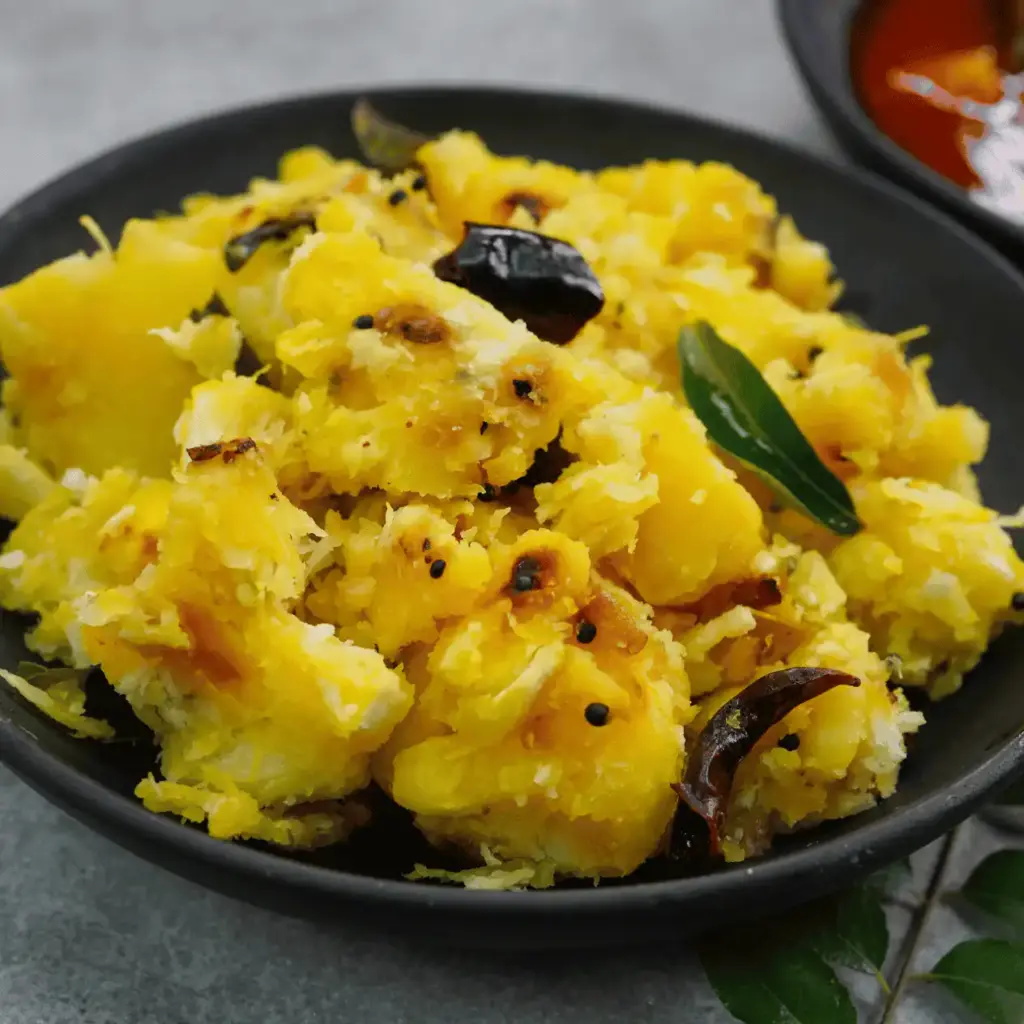
Boiled or mashed tapioca can be paired with spicy fish curry, particularly in central Kerala.
What began as an introduced crop eventually became something that many people now consider unmistakably Malayalee.
Food cultures are always evolving.
Kappa is a wonderful example.
Banana – Much More Than a Fruit

Bananas appear everywhere in Kerala cuisine.
Different varieties are eaten ripe, cooked, fried or transformed into desserts and snacks.
The Nendran banana is particularly associated with Kerala.
It is used to make the state’s famous banana chips and can also be steamed or cooked in other ways.
Even the banana leaf has an important culinary role as the traditional plate for a sadya and other meals.
In Kerala, almost every part of the banana plant seems to find a purpose.